
Introducing ALIGN (Part 1)
Strengthening the pathways for health innovations to better reach people who need it most

A rapidly changing world and global health environment call for new, disruptive approaches to existing systems so they can work better. To answer this call, we have formed the ALIGN Consortium (Advancing Country-Led Innovation Introduction through Government Engagement and EvideNce), bringing together Duke Global Health Innovation Center, the South African Medical Research Council (SAMRC), Keprecon, and ENDA Santé in support of and in partnership with the national governments of Kenya, Senegal, and South Africa. Together, in collaboration with Ministries of Health, we aim to better understand and strengthen the critical decision-making systems that guide which health product innovations are prioritized and introduced, to make those systems more effective and efficient.
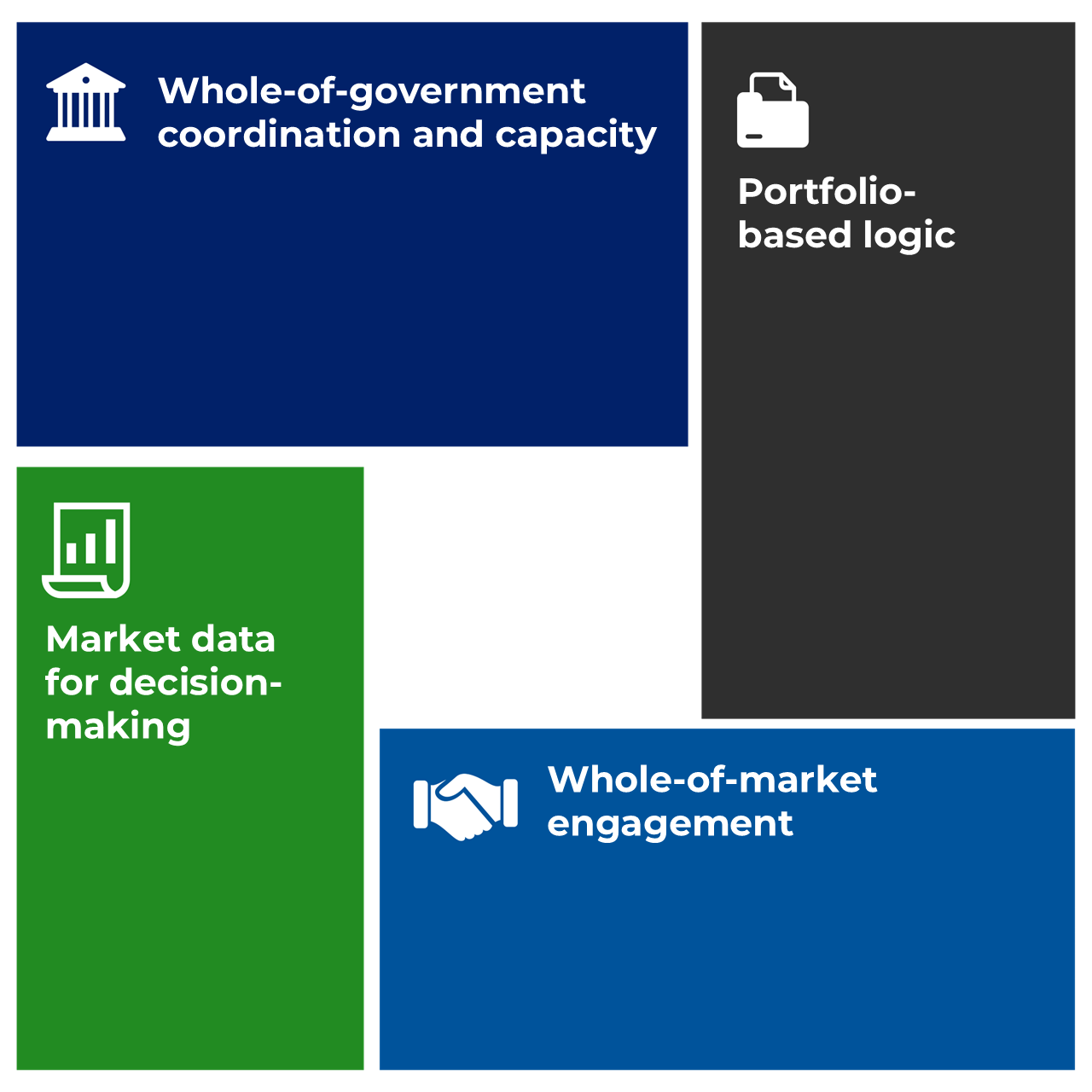
This post launches a six-part series (based on our recently published white paper) where we will dive deeper into the key challenges surrounding innovation introduction in low- and middle-income countries (LMICs), and outline how the ALIGN Consortium intends to address these issues through four interdependent pillars that can support policy and financing toward more effective and efficient innovation introduction decisions. The four pillars are:
Diagnosing the problem: what are the bottlenecks in the pathway to health innovation introduction?
New preventives, diagnostics, therapeutics, devices, and digital tools are emerging faster than many health systems can evaluate, finance, or deliver — and no system can adopt them all. In many LMICs, the challenge is not just the speed and complexity of new technologies; but also, that government adoption mechanisms were built for an earlier political and technological era, before the current wave of biologics, digital platforms and new financing realities. Within this outdated structure, access often remains slow, uneven, and too often shaped by external interests rather than by national priorities and population needs.
Health systems face tough, complex decisions on which innovations to introduce. Around the world, governments encounter an increasingly crowded health innovation landscape — from cancer to cholera, from dengue to depression to diabetes — while economic uncertainty and tight health budgets add further pressure. Country decision-makers must ask: How should we prioritize and introduce health innovations given that we cannot afford to pay for them all? Without coordination and timely information, countries struggle to make decisions and justify necessary trade-offs in ways that are evidence-informed and aligned with system priorities.
To ensure people benefit from access to strategic health innovations, countries must first focus on introducing these innovations effectively and efficiently. Innovation introduction sits at a critical inflection point between upstream R&D investment and downstream product delivery, where government stakeholders must grapple with three essential questions:
Which innovations to prioritize, and in which sequence, relative to the existing, approved offerings and others emerging on the horizon, given national health and economic priorities?
How to finance prioritized innovations to enable scaled, sustained, and fair access?
How to prepare systems for timely, safe, and sustained rollout and scale-up?
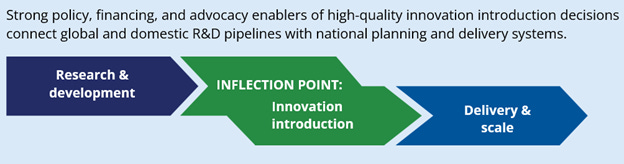
Governments often navigate these questions with limited visibility into the innovation pipeline. National and sub-national decision-makers in LMICs are increasingly asked to make high-stakes choices without timely or upstream insight into emerging technologies. Yet, global developers, funders, and intermediaries track candidates in the pipeline for years. This information asymmetry is a structural vulnerability. When policy, financing, and delivery decisions are made in isolation from pipeline insight, budget realities, health system delivery capacity, or population preferences and needs, misalignment accumulates across the pathway from product development to end-user access. This friction delays uptake, wastes scarce resources, and entrenches inequities within and across countries.
Since introduction decisions are complex, and decision-making authority is often fragmented, innovations are evaluated individually rather than as part of a coordinated strategy. This siloed approach limits opportunities for comparison and planning, leading to predictable challenges: duplication, delays, poor sequencing, and inefficiency. And when decisions are made under pressure—without visibility into timing, cost, complementarity, or system readiness—they risk eroding public confidence and consuming scarce resources that could be better spent elsewhere.
Yet even with more information, these are not easy questions. Decision-makers in LMICs must navigate constrained budgets, shifting demographics, and dual disease burdens (infectious and noncommunicable diseases) – all while advancing commitments to universal health coverage. At the same time, many countries are no longer content to wait for products to emerge at the end of the pipeline; they are increasingly seeking to shape innovation, manufacturing, and R&D agendas upstream.
Global and domestic pressures demand stronger health innovation introduction systems. The current approach is not just ineffective or inefficient; it often leaves countries disempowered. It is a system–wide problem, requiring system–wide solutions, both in LMICs and across the global health architecture. This is the dilemma the ALIGN Consortium seeks to address: how can governments strengthen their ability to say “yes” or “no” or “not yet” to new innovations for well-informed reasons, and then deliver on those choices effectively and efficiently?
What to expect from ALIGN in three pathfinder countries: Kenya, Senegal, and South Africa
Drawing on our collective experiences and established evidence on innovation introduction systems, we in the ALIGN Consortium contend that: if governments have access to portfolio tools, real-time market intelligence, and structured coordination platforms within government and across wider market actors, then they can prioritize more effectively and plan financing and delivery more efficiently. As a result, innovation introduction decisions will become timelier, evidence-informed, and aligned with national priorities, with positive effects on population health and economic resilience as well as trust in decision-makers. These benefits will increase as the global health architecture shifts to more fully support national health sovereignty and choice.
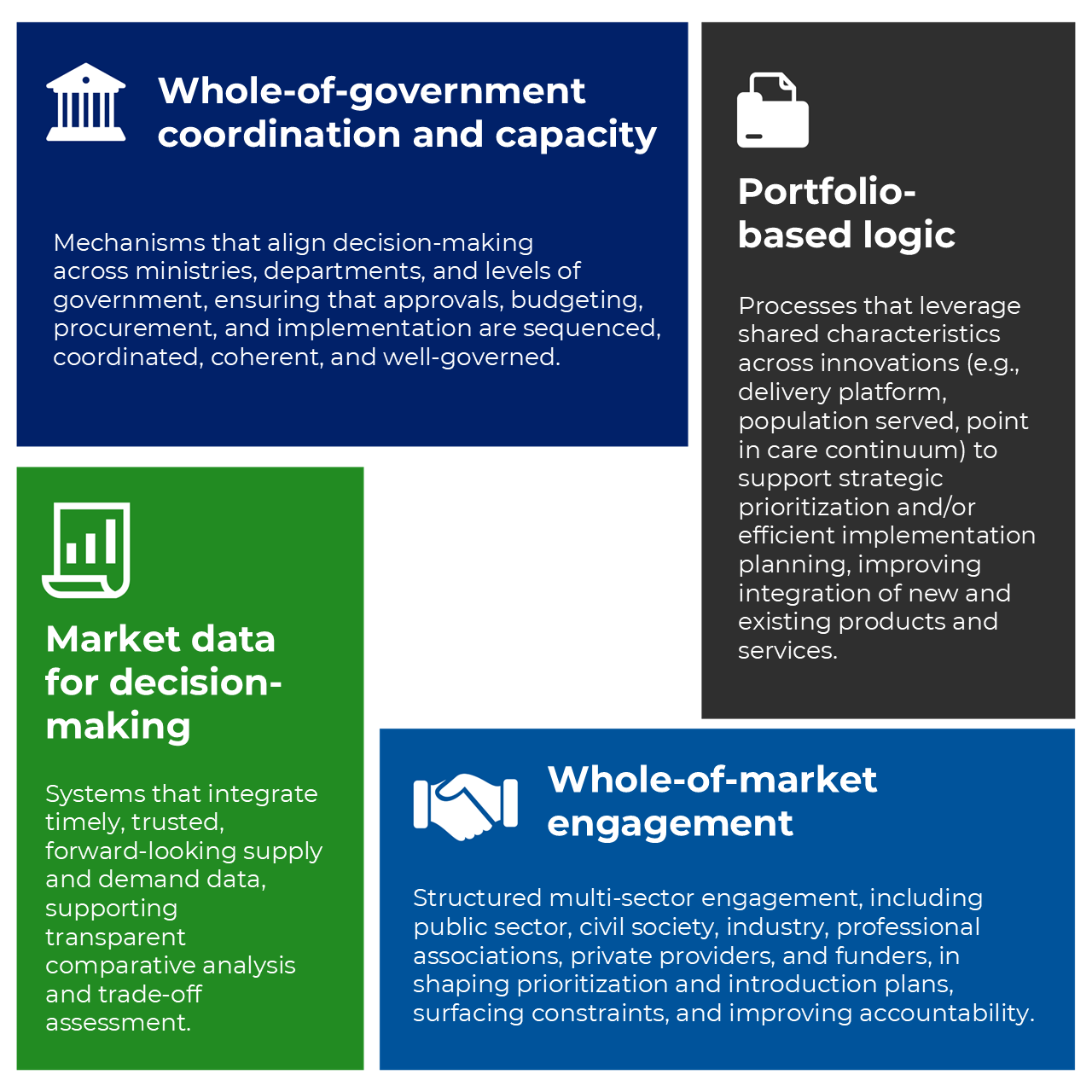
To support governments, the ALIGN Consortium focuses on four interdependent pillars that can strengthen policy and financing decisions and, ultimately, empower countries to make more effective and efficient decisions that align with national priorities. We introduce these pillars briefly here and will take a deeper dive into each throughout this series. Two pillars are anchored in relationships and capabilities that can support, synchronize, and streamline decision-making: whole-of-government coordination and capacity and whole-of-market engagement. The other two are anchored in approaches and information that can enable more strategic and coherent choices: portfolio-based logic and market data for decision-making.
This approach is necessarily experimental and experiential, even as it draws on robust evidence and country experience. We intend to learn as we go and to share key insights across countries, regions, and global platforms. Global stakeholders have historically played a pivotal role in innovation introduction in LMICs, and the ALIGN Consortium also hopes to share learnings that can inform and improve their future approaches
Follow along for the rest of the series, where we will explore each of the four pillars in depth and outline our theory of change for strengthening health innovation introduction systems. (Click here for Part 2)
Thank you for this post. The four pillars align closely with challenges we see at healthsites.io, a Digital Public Good maintaining an open, community-validated health facility registry built on OpenStreetMap.
The data pillar resonates most sharply. Fragmented, missing, or inaccurate facility data is often the invisible constraint sitting upstream of every prioritisation and delivery decision described here. You can't plan portfolio-based innovation introduction if you don't know where facilities are, what services they offer, or whether that information is current and trusted.
In Senegal, we’re addressing this through UUID-based linkage across the master facility list, ANSD boundaries, and DHIS2:
https://zenodo.org/records/10443334
With ENDA Santé as an ALIGN partner and Senegal a focus country, there’s a clear opportunity to build on existing open, interoperable infrastructure, rather than duplicating it.
Key questions:
→ How does the theory of change incorporate existing Digital Public Goods?
→ How will ALIGN engage the data commons (OSM, civil society, CHWs) as active participants?
→ What does “whole-of-market” mean when it includes open-source and volunteer networks?
We're inviting support for our next campaign to map the medical region of Tambacounda. If you’re a mapper, researcher, or health actor connected to the region, get in touch, the data will be open (ODbL) and available to all, including ALIGN.
https://healthsites.io/map?country=Senegal