
From reactive to proactive: decision-making transformed
Launching the ALIGN Global Market Intelligence Hub


These have been exciting days for the ALIGN Consortium! On April 29 in Nairobi, Kenya, we marked an important milestone: the launch of the Global Market Intelligence Hub (“Global Hub”; beta), a shared resource for better health product decision-making.
Alongside the World Health Summit Regional Meeting in Nairobi, the ALIGN Consortium and the Kenya Ministry of Health co-hosted an event convening national, regional, and global health leaders (Figure 1). We named the all-too-familiar challenges for health leaders on product introduction—high-volume and high-speed innovations, fragmented data, and reactive decision-making—and we presented our solution to these woes.
In this post, we’ll recap what we shared about our Global Hub, preview its upcoming features, rewind the tape on what a few participants said about it, and invite you to help us going forward.

Challenges for decision-makers
Leaders around the world—particularly in low- and middle-income countries—face big challenges:
1. Innovation moves faster than health systems can consider, finance, and adopt the latest advancements in diagnostics, devices, therapeutics, and vaccines.
2. Data about innovations is fragmented, siloed, and outdated.
3. Unpredictable to-market timing, low visibility into the product pipeline, constrained budgets, and external pressure lead to reactive decision-making, while national priorities, readiness, acceptability, or consideration of other innovations take a back seat.
Here’s how a few folks have put it:
“There are many products coming into the market every day. But how to prioritize them, how to make sure that they’re useful to us? That is…difficult, given the way the data is scattered all over the place.”
— Dan Odallo, Senior Programs Advisor, Keprecon (Kenya)
“Countries are often in reactive mode, and default to saying ‘yes.’ When a product is introduced, it might come with money. But what happens 5 years down the line when there is not funding?”
— Richard Osaga, Systems Engineer, Keprecon (Kenya)
Here’s the risk of these challenges, if left unaddressed: Health leaders could inadvertently squander scarce funds on innovations they can’t implement. They could also miss opportunities to choose a health innovation—or combination of innovations—that could greatly benefit the health of their people. The long-term result is unnecessary suffering as access to life-saving health innovations is delayed or denied.
We need a new approach to gathering and sharing data on health innovations so leaders can shift from reacting to preparing. And we must encourage global and regional actors to support this shift.
Introducing the ALIGN Market Intelligence Hub
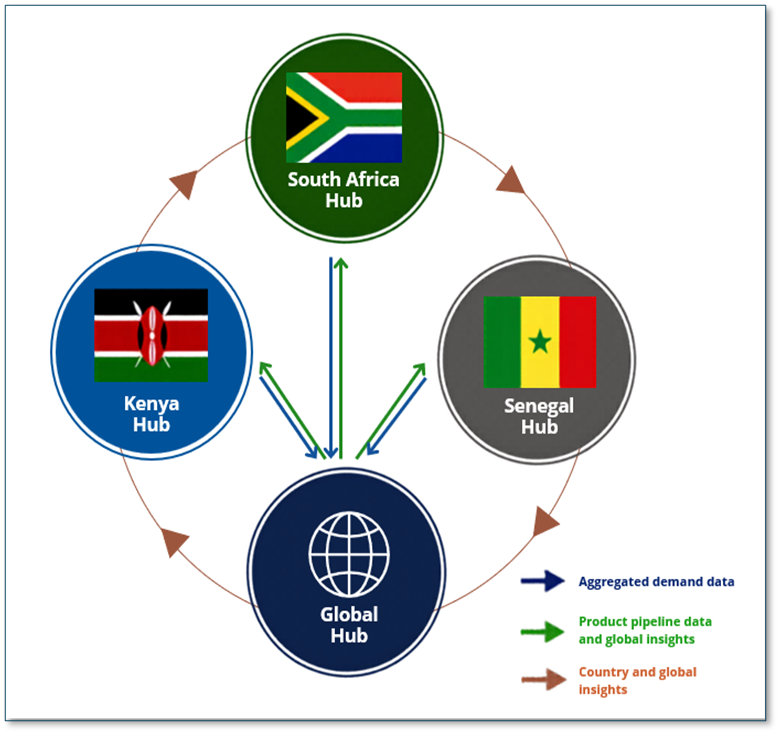
The ALIGN Market Intelligence Hub is an information-sharing platform to gather and make data available for health leaders to make better decisions on health innovations. Prizing health sovereignty—an emphasis on self-reliance, empowerment, and the ability to make contextually relevant decisions—the platform takes a federated approach and currently includes a Global Hub and three country hubs (Kenya, Senegal, and South Africa; see Figure 2). When working together, these four hubs aggregate, analyze, and translate market data on current and pipeline health innovations into decision-ready insights for governments and partners.
Launching the Global Hub
The newly-launched Global Hub gives national, regional, and global actors essential information on the health product pipeline (Figure 2).1 It serves three critical functions:
Aggregation: To address the challenge of data fragmentation, the Global Hub aggregates data from 14 sources2 into a unified, decision-ready view, supporting a comparison of nearly 300 products across four health areas.3
Automation: To address the challenge of siloed and outdated data, the Global Hub moves from manual, one-time aggregation to continuous, automated data integration. Using application programming interface,4 web scraping, and machine learning tools, the Global Hub scans data sources to reflect real-time accuracy in a fluctuating health product landscape.
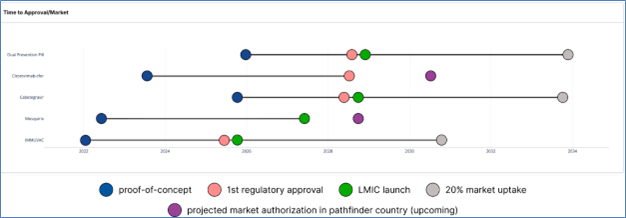
Projection: To provide decision-makers with a fuller understanding of to-market timing, the Global Hub shows likely timelines for product availability based on historic patterns (see Figure 3). Building on our previous work analyzing historical development and introduction timelines, these projections translate pipeline signals into insights—helping countries anticipate when innovations are likely to arrive which, in turn, can improve country-level financing, regulation, and delivery preparedness.
Watch this space: what else is in the works
The launch of the Global Hub is an exciting moment, but it is just the beginning. New features are coming, including:
Routine pipeline horizon-scanning and automated data acquisition.
Expansion to more databases, including better representation of innovation in Africa.
ALIGNchat, an AI-based query tool to generate tailored, decision-relevant insights.
Cost-based metrics for transparent comparison of value, affordability, and trade-offs.
System optimization tools to support portfolio-based planning and resource allocation.
In collaboration with national governments, country hubs are under development in Kenya, South Africa, and Senegal, adding local system and contextual data to available Global Hub information. Leaders will be better equipped to make decisions such as product selection, sequencing, bundling, and resource allocations to the pipeline. For example, in cooperation with the Ministry of Health, the Kenya Hub includes the targets identified in the country’s long-term development blueprint, “Kenya’s Vision 2030.”
Our Nairobi launch event generated considerable buzz, especially after the demo of the Global & Kenya Hubs:
“This was truly fascinating and exactly what the Africa region needs.”
— Nothemba Kula, Country Representative, South Africa, and Director of Partnership Liaison, Africa Region, PATH
“Before, when we made decisions, we were basically shooting in the dark. Now, we can be more focused, which also means that our resources can be better used for the things that really matter.”
— Dr. Rose Bosire, Research Clinician, Kenya Medical Research Institute
Eager for all the details? Check out our full white paper.
Chime in!
Your input makes our work stronger. Please send comments and suggestions, and help us design the best fit-for-use across the different stakeholders. For example, we would welcome:
- learning about the data you need (or have!)
- understanding new features that would benefit you
- hearing about what analyses are critical for your decision-making about health product prioritization and introduction
Complete this survey to share feedback or thoughts on the Global Hub. Or reach out with a comment, a direct message, or email to align@duke.edu.
For tips on navigating the Global Hub, visit our documentation page.
Sources include clinical trial registries, regulatory agencies, manufacturers, donors, and global health organizations.
HIV/AIDS, tuberculosis (TB), malaria, and maternal, newborn, and child health (MNCH).
APIs act as a bridge for software applications to request, access, and manipulate data without directly interacting with the database’s internal code.
 | A guest post by
|
 | A guest post by
|
 | A guest post by
|
 | A guest post by
|