
Part 5: Applying a “portfolio-based approach” can shift countries beyond product-by-product introduction
How considering multiple health innovations at once can minimize delays and maximize impact

So far in our series on strengthening innovation introduction systems, we have explored three interconnected pillars that can support health leaders to enable effective, efficient health innovation prioritization and introduction: whole-of-government coordination and capacity, whole-of-market engagement, and market intelligence for decision-making. In this post, we will take a closer look at the fourth and final pillar: a portfolio-based approach.
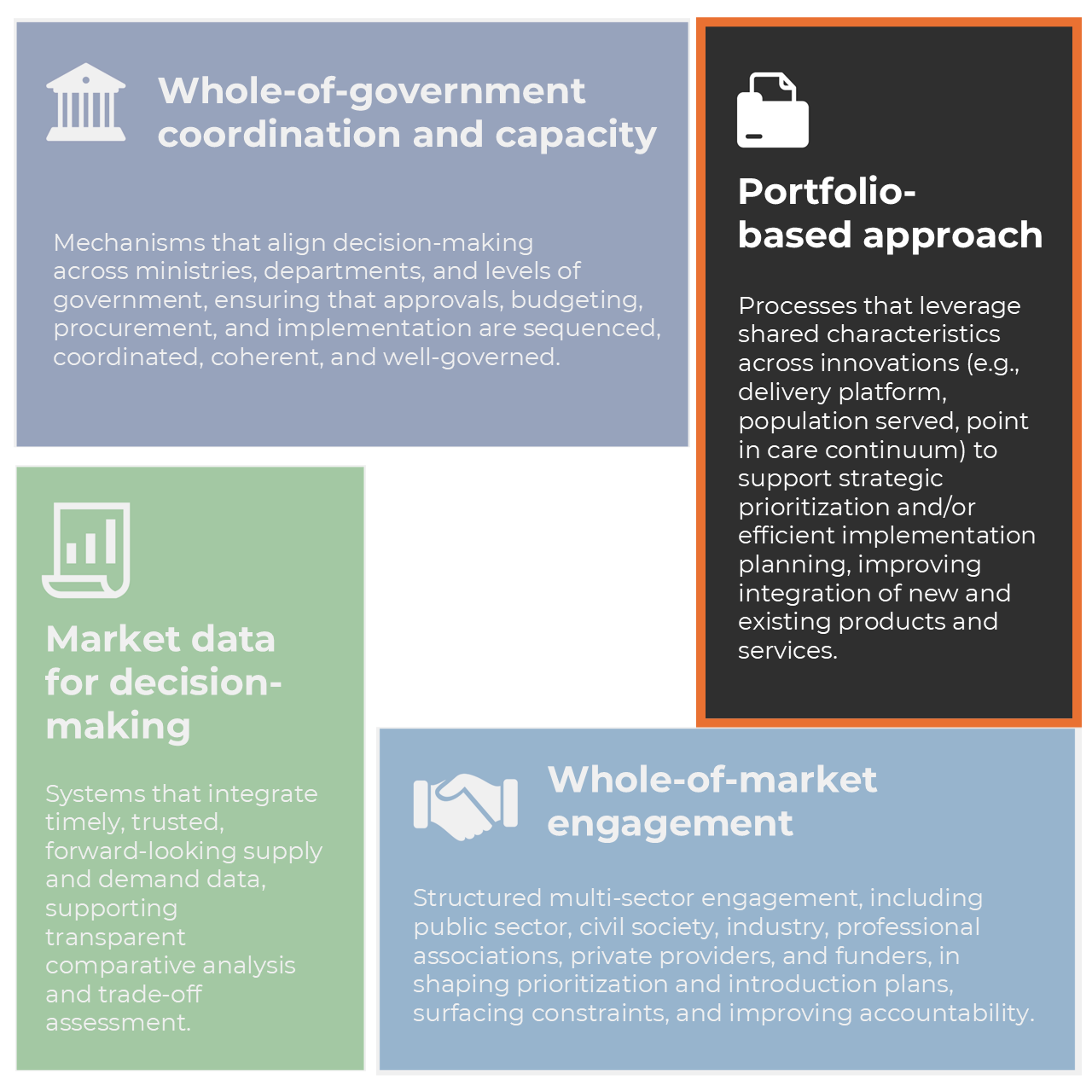
Three key takeaways:
Product-by-product introduction decisions are suboptimal and miss opportunities to gain efficiencies or maximize progress toward national health goals.
Moving to a portfolio-based approach to innovation introduction means looking across multiple innovations with threads of commonality and complementarity, including product category, population served, or population health goal.
The ALIGN Consortium is partnering with governments in Kenya, Senegal, and South Africa to explore how a portfolio-based approach can strengthen innovation introduction—and to capture and share lessons along the way.
Why the status quo isn’t working: product-by-product decisions are suboptimal
Health products rarely operate as stand-alone solutions to health challenges. Rather, they are one component of a broader toolbox of technologies and service delivery innovations used to prevent, treat, and manage health conditions.
Too often, country leaders must make product-by-product prioritization and introduction decisions. Limited visibility into innovation pipelines and timelines of availability, fragmented disease silos among both donors and within governments, and external pressures to introduce specific products often drive this fragmented approach. The result is often suboptimal decision-making. Product-by-product decisions run the risk of failing to maximize progress toward national health goals and delaying the timely review, approval, and delivery of new technologies.
Malaria prevention offers a vivid example—and is a key national priority in many countries. The recently introduced effective childhood malaria vaccine provides maximum prevention only when combined with the use of bed nets. But for bed nets to remain effective in areas with insecticide-resistant mosquitoes, innovations in insecticide-treated bed nets are required. So, if leaders are committed to ambitious goals like malaria elimination, why make decisions about new innovations one at a time?
The pipeline of global health innovations is expanding, and while many seem attractive, national health leaders need to decide which products to prioritize and introduce. However, too often current structures and decision-making processes force product-by-product decisions, without considering how new technologies fit alongside existing technologies – or those likely to reach the market in the coming years. Tools such as health technology assessment (HTA) can help evaluate individual products against key thresholds such as safety, effectiveness, and value. However, when technologies are assessed in isolation, opportunities to consider them side-by-side or as complementary combinations are often missed. Limited visibility into the broader research and development pipeline further compounds this challenge.
Applying a portfolio-based approach offers a more strategic path. By looking across multiple innovations – and even across disease areas – with shared platforms, target populations, or delivery systems, governments can make more coordinated prioritization decisions and better align innovation introduction with national health goals.
A portfolio-based approach rethinks how innovations are prioritized and introduced. Rather than assessing products one at a time, it systematically considers sets of innovations together across the full decision-making process – from prioritization to introduction – to maximize effectiveness and efficiency. This approach shifts the question from: “Should we introduce this specific product?” to “Which combination of innovations across product categories, populations, and health priorities will best advance our national goals within our capacity and constraints?”
What might a “portfolio-based approach” look like in practice?
One area where we already see this type of “portfolio” thinking to make prioritization decisions is for vaccines. Established immunization programs in countries make these a powerful lens to consider prioritization that can then be translated into efficient and effective delivery to meet health needs and priorities.
Gavi and WHO have supported the development of tools to help National Immunization Technical Advisory Groups (NITAGs) decide which new vaccines to introduce. The New Vaccine Introduction Prioritization and Sequencing Tool (NVI-PST) was designed precisely to move beyond one-vaccine-at-a-time decisions and instead look across incoming and available vaccines to prioritize those to include. Ethiopia’s NITAG recently used NVI-PST to compare six candidate vaccines at once and develop a sequenced five-year roadmap for introductions, balancing disease burden, feasibility, financing, and program constraints.
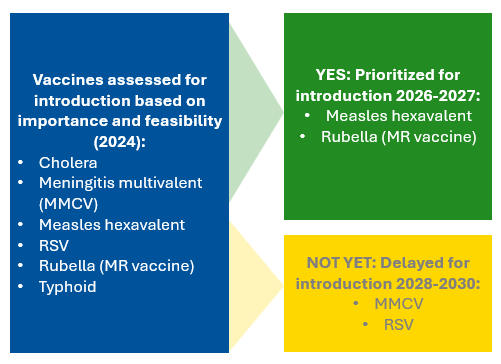
Ethiopia prioritized which new vaccines to introduce by evaluating the candidates next to one another
Of course, vaccines are just one type of innovation countries must make decisions on and plan to introduce, but national governments aren’t able to easily compare trade-offs or identify synergies and efficiencies across vaccines, drugs, devices, diagnostics, and other innovations for multiple health needs and populations. Extending a portfolio-based approach to allow comparisons and combinations across a range of innovations can inform introduction of the best-fit tools to meet national goals and policy priorities.
Portfolios should be anchored in threads of commonality or complementarity such as improved health outcomes or cost efficiencies when used in combination, such as:
Product features – Shared features such as the administration method (e.g., long-acting injectable) or storage requirements (e.g., cold chain) may offer opportunities to streamline regulatory review, supply chain planning, facility readiness, or healthcare provider training.
Populations served – Subsets of the population may share similar health risks (e.g., adolescent girls) or care needs (e.g., cancer patients) that can be considered together as comprehensive care packages when planning budgets, benefits, or continuums of care.
Point of care – The type of facility (e.g., clinic, pharmacy, or large medical center) or service/care being provided (e.g., child wellness exams or prenatal care) when a patient interacts with the health system may also provide opportunities to coordinate delivery, training, and supply chains across multiple interventions.
Let’s consider an example of a portfolio for a population served – adolescent girls and young women. Improving health for this group requires more than a single intervention. It means delivering a set of complementary interventions across multiple health areas. A portfolio might include HPV vaccination, menstrual-health products, contraceptives, HIV prevention and testing, depression screening tools, nutritional supplementation or anemia diagnostics, and digital self-care tools. Using a portfolio-based lens can help inform effective prioritization – identifying combinations of interventions that best serve this population and align with national priorities (e.g., selecting products covered by national health insurance that will complement each other). It also supports more efficient delivery of those products, from integrated provider trainings to coordinated, evidence-based communication.
What the ALIGN Consortium is doing?
Applying a portfolio-based approach to innovation prioritization and introduction builds upon significant work already underway, such as for vaccines, or bundles for specific needs, such as the E-MOTIVE package to address post-partum hemorrhage. We believe that applying this portfolio-based approach to innovation prioritization and introduction more broadly, countries and partners can better identify trade-offs, align sequencing, reduce duplication, and make more strategic use of limited resources.
But experience shows that applying this method broadly and consistently takes careful planning and execution. Gavi’s portfolio planning demonstrates that as complexity increases, decision timelines can lengthen, and coordination demands rise. Similarly, PATH and WHO’s work on bundling found efficiency gains came with higher technical burden on ministries, especially where analytic or coordination capacity was limited.
To be useful, portfolio approaches must be flexible, context-specific, and regularly reviewed to avoid introducing new bottlenecks. Learning from other systems and building upon existing national assets is critical. To support our government partners and other key stakeholders, ALIGN is taking the following actions:
Learning global lessons: We are synthesizing lessons from experiences around the world to identify the functions and structural options that matter most. These insights will inform how government leaders across Kenya, Senegal, and South Africa—and beyond—apply a portfolio-based approach and inform decision-making.
Assessing the national landscape: We are mapping existing platforms and processes—such as planning tools, investment cases, program scorecards, joint campaigns, and innovation review committees—while identifying overlaps, duplications, and conflicts. Applying and strengthening a portfolio-based approach often doesn’t require new institutions; early progress can come from repurposing and reorienting existing tools, processes, or structures.
Specifying national priorities: Government-led conversations are also helping clarify national priorities. For example, targeting reduction in maternal mortality provides a clear outcome that can guide selection of the right combination of existing and emerging innovations to optimize outcomes with effectiveness and efficiency. These conversations also support the co-development of principles for grouping, sequencing, and bundling innovations within existing decision-making frameworks.
What’s next?
We believe that a portfolio-based approach – when combined with market intelligence and both whole-of-market and whole-of-government coordination – can be a powerful tool for finding efficiencies and complementarities among health innovations and matching the best-fit innovations that can enable countries to optimize value. As we advance a portfolio-based approach for product prioritization and introduction with government leaders in Kenya, South Africa, and Senegal, and other key national, regional, and global stakeholders, we invite broad engagement and input from diverse perspectives.
Please connect with us (comment, message, or email us at align@dm.duke.edu) to share your ideas, experiences, and feedback on this important approach to improve innovation prioritization and introduction:
What portfolio approaches do you think are most promising based on experience and evidence?
Where is more evidence needed to inform policymakers?
How can we help break down the silos among disease programs and product categories to better serve the needs of people and improve country-level prioritization and introduction decisions?
Our next and final post of this series will once again bring these pillars together to emphasize how, when strengthened together and viewed as a whole, countries can optimize innovation prioritization and introduction.